I've been quiet about the status of my solar system for a few months now, and there's a good reason for that. Sometime in May, things got weird, and it took until late July to un-weird them, and the result of that process didn't become apparent until, well, today, in early August.
We entered May feeling optimistic. We'd seen our first power bill charging only for delivery and fees, not grid consumption. At the end of a period with sunny and dry weather, we expected more sun and more days producing more power than consuming, or at least offsetting high consumption from the use of AC and the pool heater. Yet in that same peppy post from May 1, I noticed that production in March was higher than that of April. In hindsight, I should have seen that as a red flag.
Things got weird in the month of May. Production came in below April and by a lot: 731 kWh versus 865 kWh. That by itself is weird. Days get longer in May, and the weather generally gets sunnier as summer approaches. It really should have been accelerating, not slowing down. I reckoned the weather was a factor: It was an unusually cloudy month for May, with several rainy days in the second half of the month.

I also suspected that perhaps the panels were dirty. The same tree pollen that coated my car with a fine dusty patina appeared also to coat the panels. (You can kind of see it in the picture of the back array at left.) In one funny moment, I took my water compressor and tried to manufacture some "rain" on the front panels. It was fun to try, but it made no difference.
As the month progressed, my concern mounted. I put in a call to our vendor, Kasselman Solar, who sent out a service rep to take a closer look. (She quickly dismissed my theory about the pollen dust.) Communication, it seems, between one of the basement inverters and its home base stuck out right away as an apparent problem. The location of my home has exceptionally bad cellular phone coverage, and the SolarEdge inverter relies on a cellular modem to report its production and output, including its exported power to the utility grid. That old saying "proof or it didn't happen" applies here. If the inverter can't report exported power, I don't get credit for it on my bill, end of story. And those credits are essentially the reason the entire system exists.
One of the two inverters, it turned out, wasn't communicating at all. It had a faulty comms board, the internal part that talks to the cellular modem. Either the board or the inverter itself would have to be replaced.
By mid-June, a new inverter had been swapped in and all seemed to be on its way to resolution. Yet as June swung into July, production still didn't rise to a reasonable level. Weather continued to present a challenge. June and the first week or so of July were marked by numerous severe thunderstorms and flooding in the Hudson Valley. I couldn't really expect high production numbers under those conditions. (That dust I had worried about? Totally gone.)
Yet as the weather conditions improved, the needle still didn't move meaningfully. In July of 2022, the first full month of the system's production, the system produced 1.43 mWh. In July of 2023, I produced 732 kWh, or about half the level from the year-ago period. Something was clearly amiss.
A second service visit from Kasselman revealed the problem: In the technician's argot "One of your strings is down." It meant — I think — that a line connecting some of the panels to the inverter was not working. The source of the problem, it was later revealed, was a "bad crimp," which again I think meant either a faulty component or a poor connection. "Bad crimps happen," he said. Okay then. He and a colleague climbed up on the roof, fixed what had to be fixed, and that was that. Problem solved? Not just yet.
The communication problem was still unsolved and appears as of today to have been more significant than I realized. In parallel to all this I had been struggling with steadily worsening Wi-Fi around the house and had decided to upgrade it. Wherever I live, I make a point to get the fastest Internet connection I have, and so I have a 1-gigabit plan from the local cable company.
But the trio of TP-Link Deco M4 Wi-Fi routers the cable installer had suggested just weren't getting the job done. They seemed overwhelmed by all the connected devices in the house: Three phones, three iPads, a smart TV, smart lights, a connected washer, dryer, dishwasher, oven, and fridge, three always-on computers, network-attached storage, a smart speaker system. You get the idea.
I went looking for a more robust mesh router system. I turned to Wirecutter, the product review team at The New York Times, and read their reviews of wireless mesh systems and settled on the Asus Zen WiFi AX. I bought a set of two and liked the results. (My cable connection is still wonky, but I'm hoping for an upgrade to fiber optics sometime soonish.)
In anticipation of the second visit from Kasselman's technicians, I bought another set of two. All in the upgrade cost me $700. It seems to have been worth it.
In a conversation with the Kasselman service manager, I learned that the SolarEdge inverters are not approved by the FCC to connect to Wi-Fi, but if a router is close by, a technician
can connect it to the Internet via an ethernet cable. This is where the Asus routers made a difference. The main router creates a 5 GHz "backhaul" connection to feed the other Wi-Fi nodes stationed around the house. One of the new routers, I reasoned, if placed in the basement and connected by ethernet, would give that inverter a clear no-excuses connection to report its status. On that second service visit, after the fix on the crimp and the string, I had that fourth router powered up and ready for them to connect to the inverter. Now it's sitting on top of the home battery. Eventually, I'll mount a shelf there.
Today is the first day that it became clear that we're in a different phase with the solar system. The data connection is working, and SolarEdge has updated its monitoring apps, and the data is just looking different than before. And by different, I mean, better. So much better.
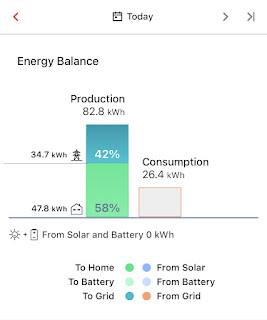
Last year, the most productive days of the summer peaked at about 60 kWh. This week we've already seen two days with production north of 80 kWh. As I write the sun is setting on the third day this week with production north of 82 kWh, of which more than 40 percent has been exported to the grid. And since temps have been in the mid-70s, our use of the AC has declined, keeping overall consumption down.
It almost seems like the entire system has been running at less than its full capacity since installation. I'm going to try not to think about all the missed sunlight over the last year, and focus instead on the prospect of improved performance ahead. If this is the new normal for sunny mid-summer days then that is very good news indeed.
One thing I definitely learned: If you live in an area where cellular coverage is anything less than ideal,
do whatever it takes to get a hardwired Internet connection to the inverter. That data link is a lot more important than I ever realized.


